Cardiac~45–60 min
Exercise Stress Test
A treadmill test that monitors your heart's performance while walking or running to detect reduced blood flow to the heart muscle.
The exercise treadmill stress test evaluates the heart's electrical and haemodynamic response to progressive physical exertion — detecting ischaemia, arrhythmias, and other cardiac abnormalities that only appear under physical stress.
Book This Evaluation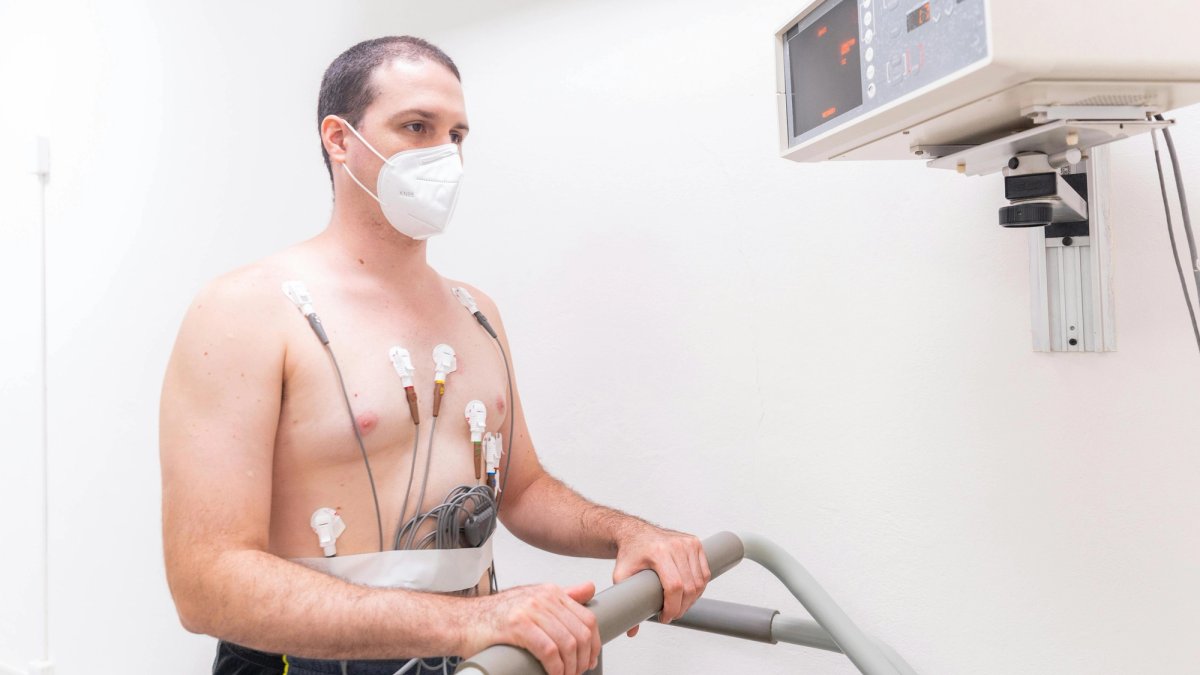
The exercise stress test evaluates how well your heart handles increased workload, helping uncover coronary blockages.
Why We Make the Heart Work Harder
A narrowed coronary artery often lets enough blood through at rest to cause no trouble at all. The problem only shows up when the heart has to work harder — climbing stairs, hurrying for a bus, carrying the shopping.
The exercise stress test recreates that demand in a controlled setting. As you walk on a treadmill that gets progressively faster and steeper, we watch the ECG for the tell-tale changes of a heart muscle not getting enough blood, track your blood pressure, and note the symptoms you develop and at what workload. It is a simple, well-proven first-line test for suspected coronary artery disease.
The exercise stress test recreates that demand in a controlled setting. As you walk on a treadmill that gets progressively faster and steeper, we watch the ECG for the tell-tale changes of a heart muscle not getting enough blood, track your blood pressure, and note the symptoms you develop and at what workload. It is a simple, well-proven first-line test for suspected coronary artery disease.

What the Test Is Like
Ten electrodes are stuck to your chest and a blood pressure cuff to your arm. You start by walking slowly on a gentle slope; every three minutes the treadmill speeds up and tilts further. Most people manage 6 to 12 minutes. We stop when you reach the target heart rate for your age, when you have had enough, or if the ECG or blood pressure tells us to. Dr. Chang is present throughout. Wear comfortable shoes and clothes you can move in, and skip a heavy meal in the two hours beforehand.
What It Shows
The test reports on several things at once:
- Ischaemia — ST-segment changes on the ECG that suggest a significant coronary narrowing
- Rhythm disturbances that only appear on exertion
- How your blood pressure responds to exercise — a fall is a warning sign
- Your exercise capacity in METs, a strong independent predictor of long-term outcome
- Whether your usual symptoms are reproduced, and at what level of effort
When We Recommend One in Singapore
A treadmill test is most useful when the likelihood of coronary disease is moderate rather than very low or very high.
- Chest tightness or breathlessness that comes on with exertion and eases with rest
- Assessing someone with known coronary disease or after a stent
- Clearance before starting vigorous exercise, particularly over 40 with risk factors
- It is not suitable straight after a heart attack, with unstable symptoms, severe aortic valve narrowing, or an uncontrolled rhythm — we use a scan-based test instead
- Privately in Singapore a treadmill stress test costs roughly SGD 250 to SGD 450 and Medisave can often be applied when done for symptoms
Understanding Your Result
Dr. Chang explains the result against the Duke Treadmill Score, which combines exercise time, ECG changes and symptoms into a risk estimate. A strongly positive test, or one that turns positive at a low workload, usually leads on to a CT coronary angiogram or an invasive angiogram. A clearly negative test in someone who exercised well is reassuring. Around one in ten tests is inconclusive — neither clearly normal nor abnormal — and then an imaging test such as a stress echocardiogram or CT angiogram gives the clearer answer.
Exercise Stress Test: Common Questions
Ready to Schedule Your Exercise Stress Test?
Most evaluations are available on the same day as your consultation with Dr. Peter Chang at Paragon Medical Centre, Singapore.