Imaging~1–2 hrs
Cardiac CT Angiography
An advanced imaging test that provides detailed 3D pictures of your heart and blood vessels to detect blockages.
Cardiac CT angiography (CTCA) uses high-resolution, ECG-gated CT with intravenous contrast to produce detailed three-dimensional images of the coronary arteries. CT-FFR extends this by assessing the functional significance of arterial narrowing without catheterisation.
Book This Evaluation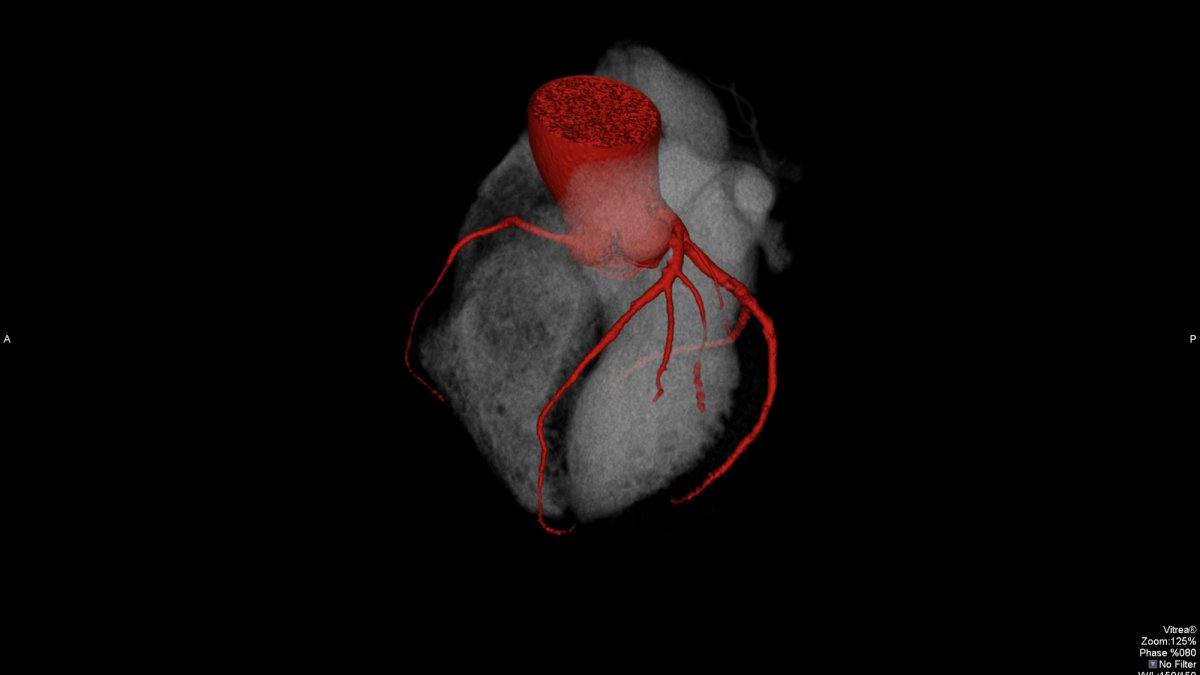
Advanced CT imaging produces detailed 3D visualizations of the coronary arteries, identifying blockages without invasive surgery.
A Look Inside the Arteries Without a Catheter
For decades, the only way to see inside the coronary arteries was an invasive angiogram — a catheter threaded up from the wrist or groin. Cardiac CT angiography now does much of the same job from the outside.
A short injection of iodine contrast lights up the arteries, and a fast, ECG-synchronised CT scanner freezes the beating heart to build a detailed three-dimensional map. It shows not just the narrowings but the plaque in the artery wall itself — including the soft, non-calcified plaque a calcium score cannot see. For stable chest pain, it is now the recommended first test in most international guidelines.
A short injection of iodine contrast lights up the arteries, and a fast, ECG-synchronised CT scanner freezes the beating heart to build a detailed three-dimensional map. It shows not just the narrowings but the plaque in the artery wall itself — including the soft, non-calcified plaque a calcium score cannot see. For stable chest pain, it is now the recommended first test in most international guidelines.

How the Scan Works
A slow heart rate gives the sharpest pictures, so you may be given a beta-blocker tablet an hour beforehand to bring the rate below about 65. A cannula goes into a vein for the contrast, and a small spray of nitrate under the tongue widens the arteries. The scan itself lasts a single breath-hold of a few seconds. Plan for one to two hours in total. Fast for four hours beforehand and avoid caffeine that day, since it works against the beta-blocker.
What the Result Tells Us (CAD-RADS)
Findings are graded on the standardised CAD-RADS scale:
- CAD-RADS 0–2 — no or minor narrowing; medication and risk-factor control, and chest pain is very unlikely to be from the heart
- CAD-RADS 3 — a 50 to 69% narrowing; a CT-FFR analysis can work out from the same scan whether it is actually limiting blood flow
- CAD-RADS 4–5 — a narrowing of 70% or more, or a blockage; usually leads on to an invasive angiogram with a view to a stent
When We Recommend One in Singapore
CT angiography is the test of choice in several common situations.
- Stable chest tightness or breathlessness where the likelihood of coronary disease is low to moderate
- An inconclusive or borderline treadmill or stress test
- New heart failure or atrial fibrillation where a coronary cause needs to be ruled out
- Assessing a known coronary anomaly or the grafts after bypass surgery
- It is less useful with a very high calcium score, an irregular fast heart rate, or significant kidney impairment; privately in Singapore it costs roughly SGD 800 to SGD 1,500
After the Scan
A radiologist and Dr. Chang review the images together. A normal CT angiogram is one of the most powerful reassurances in cardiology — it makes significant coronary disease very unlikely for years to come. Where disease is found, the scan guides the next step precisely: intensifying medication for mild or moderate disease, or proceeding to an invasive angiogram and stent for a tight, flow-limiting narrowing. The soft-plaque information also sharpens how aggressively we treat cholesterol.
Cardiac CT Angiography: Common Questions
Ready to Schedule Your Cardiac CT Angiography?
Most evaluations are available on the same day as your consultation with Dr. Peter Chang at Paragon Medical Centre, Singapore.