Vascular~15–20 min
Ankle Brachial Index (ABI)
A quick blood pressure test on your arms and ankles that checks for poor circulation in your legs.
The ankle-brachial index (ABI) is a simple, non-invasive test that compares blood pressure in the ankle to the arm — the primary screening tool for peripheral artery disease (PAD). Patients with an ABI below 0.9 face a two- to threefold increased risk of myocardial infarction and stroke.
Book This Evaluation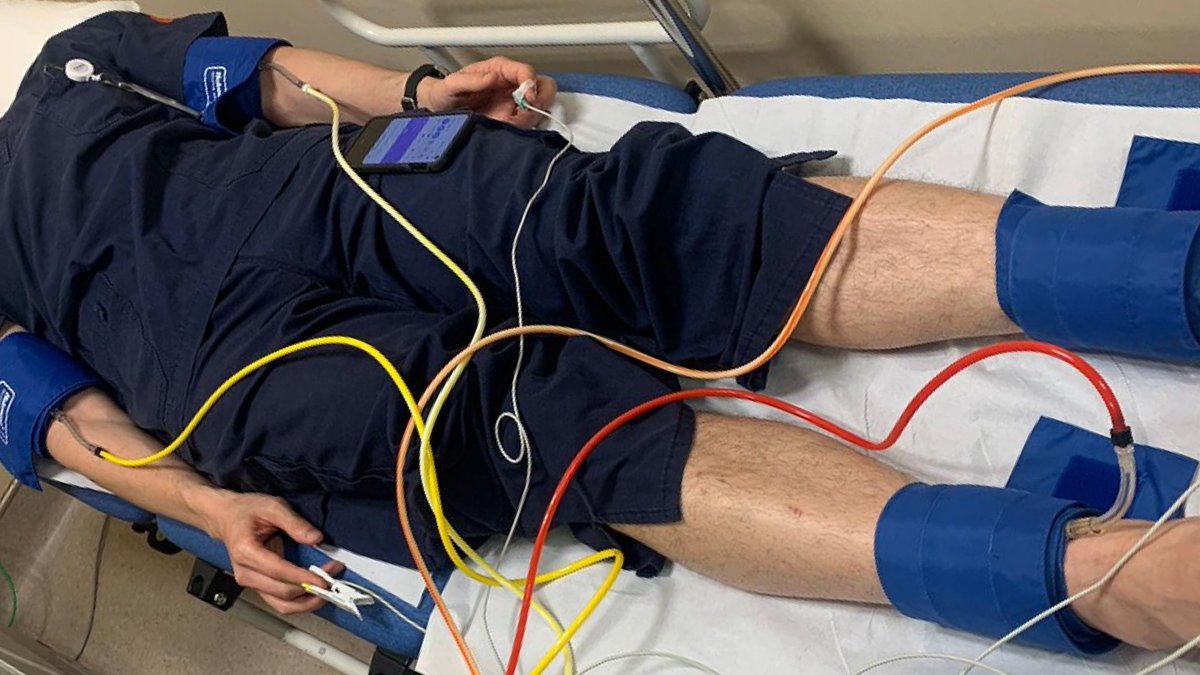
By comparing blood pressure at the ankle with that at the arm, the ABI test reliably identifies poor leg circulation.
A Simple Number for Leg Circulation
When the arteries supplying the legs narrow with plaque — peripheral arterial disease — the blood pressure measured at the ankle drops below the pressure in the arm. The ankle-brachial index is simply the ratio of the two.
It is one of the most informative tests in vascular medicine for the effort involved: a few blood pressure cuffs and a Doppler probe, no needles, no preparation. A low result confirms reduced leg circulation, and it also flags a person whose heart and brain arteries are very likely affected too — an ABI below 0.9 roughly doubles or trebles the risk of a heart attack or stroke.
It is one of the most informative tests in vascular medicine for the effort involved: a few blood pressure cuffs and a Doppler probe, no needles, no preparation. A low result confirms reduced leg circulation, and it also flags a person whose heart and brain arteries are very likely affected too — an ABI below 0.9 roughly doubles or trebles the risk of a heart attack or stroke.

What the Test Involves
You rest lying down for about five minutes, then blood pressure cuffs are placed on both arms and both ankles. A small handheld Doppler is used to hear the pulse as each cuff deflates, giving an accurate pressure at each point. The ankle readings are divided by the higher arm reading. The whole thing takes around 15 minutes, is painless, and you can leave straight away.
Reading the Result
The index falls into set bands:
- 1.00–1.40 — normal
- 0.91–0.99 — borderline; worth repeating with exercise
- 0.41–0.90 — mild to moderate peripheral arterial disease, fitting with cramping calf pain on walking
- 0.40 or below — severe disease; needs prompt vascular referral
- Above 1.40 — stiff, calcified arteries that will not compress, common in diabetes and kidney disease; a toe-pressure or ultrasound is needed instead
Who Should Have It in Singapore
An ABI is recommended for:
- Cramping pain in the calf or thigh that comes on walking a set distance and eases with rest
- A foot or leg wound that is slow to heal, or rest pain in the foot at night
- Adults over 65, or over 50 with diabetes or a smoking history
- Anyone with known coronary or carotid disease, to gauge the overall arterial picture
- Privately in Singapore an ABI test costs roughly SGD 80 to SGD 200 and is often bundled into a vascular assessment
What Happens Next
A normal ABI in someone with leg pain points the search elsewhere — often the spine or the veins. A reduced value confirms peripheral arterial disease, and the cornerstone of treatment is the same regardless of severity: stopping smoking, a statin and an antiplatelet, blood pressure and diabetes control, and a structured walking programme, which genuinely lengthens walking distance. Severe disease with rest pain or tissue loss is referred urgently for angioplasty or bypass to save the limb.
Ankle Brachial Index (ABI): Common Questions
Ready to Schedule Your Ankle Brachial Index (ABI)?
Most evaluations are available on the same day as your consultation with Dr. Peter Chang at Paragon Medical Centre, Singapore.