Corona Phlebectatica: Closer to a Leg Ulcer Than You Think
Dr. Peter Chang
Triple Board-Certified Cardiologist & Vascular Specialist

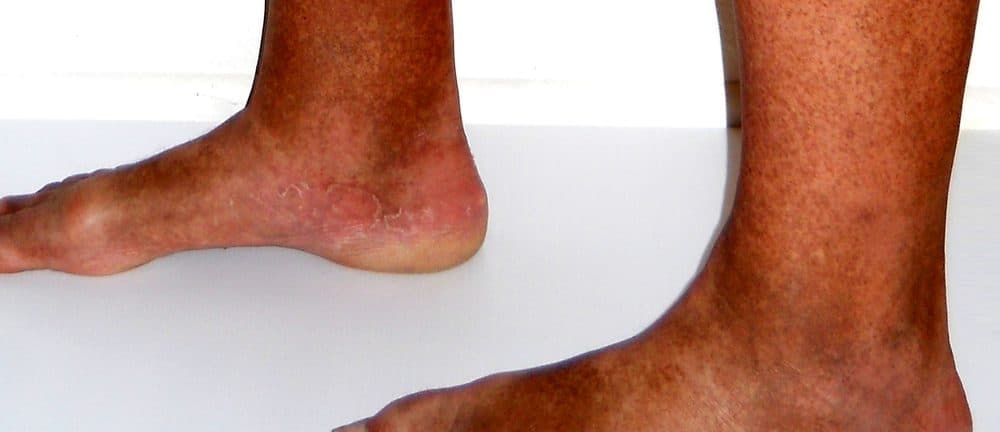
What Corona Phlebectatica Actually Is
Unlike the fine spider veins many people have on the thigh or calf, this pattern is specific to the ankle and specific in meaning. We see it often in our Singapore clinic in people who have had visible varicose veins or aching, swollen legs for years and assumed nothing was progressing.
Photo: cropped from ‘Mild chronic venous insufficiency’ by James Heilman, MD — Wikimedia Commons, CC BY-SA 4.0. It shows venous skin changes at the ankle, the region where corona phlebectatica develops.
Where CEAP C4c Sits in the Classification
C4c was added as its own subclass only in the 2020 update of CEAP, precisely because the evidence showed it carries prognostic weight of its own. In practical terms, being told you are ‘C4c’ in Singapore means your venous disease has moved from a cosmetic and comfort problem to a skin problem, one step below an ulcer.
How Much It Raises Your Risk of a Leg Ulcer
To put it plainly: corona phlebectatica roughly quadruples the odds that the skin at that ankle will eventually break down. It sits alongside a hardened skin texture, a previous deep vein thrombosis, obesity and smoking as the recognised warning signs. A venous ulcer is slow to heal, prone to coming back, and a common reason for repeated clinic visits in Singapore, so this is a risk worth heading off early.
Why It Means the Deep Problem Has Progressed
The link with incompetent perforating veins at the ankle is particularly strong. Those little vessels are being forced to carry pressure they were never meant to hold, and the fan of dilated capillaries is the overflow. That is why we treat corona phlebectatica as a prompt to map the whole venous system, not as a reason to zap a few surface veins and move on. The surface finding is a messenger; the message is about the plumbing underneath.

What to Do If You See It: Assessment in Singapore
In Singapore, a venous reflux scan in a private clinic costs roughly SGD 250 to SGD 450, and a first consultation with a vascular specialist about SGD 150 to SGD 350. Medisave and most insurers cover investigation and treatment when there are skin changes such as corona phlebectatica, because at that point it is a medical problem rather than a cosmetic one. Bring a list of your medications and any history of leg clots.

Treatment: Closing the Loop Before the Skin Breaks
The second half is protecting the skin while it recovers: daily medical-grade compression (typically 20 to 30 mmHg or higher), a simple moisturiser to keep the skin barrier intact, leg elevation when resting, regular walking to work the calf pump, and losing excess weight. Done together, these measures can stop corona phlebectatica progressing to an ulcer, and they markedly reduce the chance of an ulcer returning if you have already had one.
When to See a Vascular Specialist
In Singapore you do not need a referral to see a vascular or venous specialist privately. A normal-looking leg with only surface spider veins can wait; a leg showing corona phlebectatica should be looked at properly, because the window where a 45-minute scan and a keyhole procedure prevent an ulcer is exactly now.
Frequently Asked Questions
Common Questions About Corona Phlebectatica
What is corona phlebectatica?
It is a fan-shaped cluster of small dilated veins around the ankle and foot, usually on the inner side, caused by long-standing high pressure in the leg veins. It is also called ankle flare or malleolar flare. In the CEAP classification it is graded C4c, meaning chronic venous disease has begun to affect the skin.
Is corona phlebectatica serious?
It is more serious than it looks. It is not painful in itself, but it is a marker that venous disease has reached the skin, one step below an ulcer. Studies show it raises the odds of a future venous leg ulcer roughly four to five times. It is a clear signal to have the veins assessed rather than ignored.
Can corona phlebectatica be reversed?
The visible veins themselves usually do not disappear completely. What treatment can do is stop the process behind them. Correcting the underlying venous reflux and wearing daily compression lowers the ankle pressure driving the changes, halts progression, and substantially cuts the risk of the skin breaking down into an ulcer.
How is corona phlebectatica treated in Singapore?
First, a standing duplex ultrasound maps the faulty veins. Then the underlying reflux is treated, usually by endovenous ablation of the saphenous vein under local anaesthetic, sometimes with foam sclerotherapy or perforator treatment. Daily medical-grade compression stockings, skin care, leg elevation and walking protect the skin. Medisave and insurance generally cover this once skin changes are present.
Does corona phlebectatica mean I will get a leg ulcer?
No. It raises the odds of a venous ulcer around fourfold, but it is not a certainty. Most people who have the underlying vein problem treated and wear compression consistently never go on to ulcerate. The risk is real but very modifiable, which is exactly why acting at this stage is worthwhile.
Which doctor treats corona phlebectatica in Singapore?
A vascular or venous specialist. They will arrange a duplex ultrasound, explain what the scan shows, and discuss whether you need a procedure, compression alone, or both. You do not need a GP referral to see one privately in Singapore. Dr. Peter Chang assesses and treats venous disease at Paragon Medical Centre on Orchard Road.